



Do you have a whole house to keep warm, or a specific room you want heated in the cold winter months? One of the most efficient ways to heat your home in Melbourne is with a split system, but where do you put it? What factors are in play for the best placement? Does it matter if it’s on a north-facing wall? Is there a maximum room size impacting efficiency?
Let’s take a look at where the best place is to install a split system in your home for maximum warmth during winter.
The Right Split System in the Wrong Place Won’t Heat Your Home Efficiently
The efficiency of a split system relies heavily on its placement in your home. Put it in the wrong spot and you’ve got uneven temperatures and drafts that cause the system to consume more energy just to compensate.
The team at Templestowe Heating and Cooling are experts at assessing your home and finding the perfect place to install a split system so you can be toasty warm without breaking the bank with power bills.
We’ve written this article for you to understand that installing a split system is more than just putting it on any wall you want. Once you’re fully informed about the best place to install a reverse cycle unit, and why, give our team a call and we can get one into your home before your toes freeze.
How a Split System Actually Heats a Room
This may sound strange, but split systems don’t actually generate heat. What they do is use electricity to absorb ambient thermal energy from the outside air and transfer it inside. This makes them incredibly efficient, in that they’re not trying to heat up the air inside the room.
- Heat Absorption. Even when the air outside is nippy, there is enough thermal energy for the process. The liquid refrigerant inside the outdoor unit absorbs the ambient heat, which then boils and turns into a cold gas.
- Compression. This gas is then pumped through copper pipes into the compressor, which is located in the outdoor unit. This compression forces molecules close together which heats up air and the pressure of the refrigerant.
- Heat Release. The heated, high-pressure gas is piped to the interior, wall-mounted unit. As a fan blows your room’s air over the hot coils, the refrigerant releases its heat, warming the air before it enters your room. As it loses heat, the refrigerant condenses back into a warm liquid.
- Expansion. The liquid refrigerant passes through an expansion valve on its way back outside. This sudden drop in pressure rapidly cools the liquid down, making it ready to absorb more heat from the outside air and begin the continuous cycle again.
The Golden Rule – Install High, Heat Low
This rule helps maximise the efficiency of your split system unit. Warm air is less dense than cold air so it rises. Cold air is denser, so it sinks. If you get it right, you can take advantage of the natural convection currents of hot and cold air to warm your home faster.
Heat Low for Heating
The best place for a split system to heat your room is low on the wall, so the hot air can start low and rise to the ceiling, warming more of the room as it does so. However, this is not very practical for the unit itself.
Split systems are installed for all-year-round functionality, generally installed near the roof to get out of the way. Great for cooling rooms, not so much for heating them. So, to help with the heating, you need to adjust the louvres to point straight down while using the heating cycle. This will drive hot air down towards the floor, to then rise up to the ceiling, rather than blowing out high up and just going right to the ceiling.
Which Room Should Your Split System Go In First?
If you’re on a budget, the best advice is to install it in the room you’ll be using the most. Generally this would be the lounge room or living area, where you eat, or relax in front of the television on the couch.
After the lounge rooms we recommend bedrooms. This is a great choice especially using a timing setting, so you can heat your room prior to going to bed. Offset the split system so it doesn’t blow directly onto your bed.
The next best option for split system installation would be a home office. It tends to be where a lot of time is spent, so being comfortable there while you work is ideal.
Open Plan Living. How Many Split Systems Do You Actually Need?
For most standard open-plan layouts up to 55 m², one large split system (6.0 kW to 8.0 kW) is usually sufficient.
However, if your space is L-shaped, spans over 60 m², or features high ceilings, two smaller split systems (e.g., a 5.0 kW and a 3.5 kW) will provide vastly superior airflow and zoned control
Single Large System (6.0 kW – 8.0 kW)
This system is best for a regularly rectangular room and open plan space, or an area with an open kitchen, eating, living area style of space. It has a lower upfront installation cost, as it is only one unit, but it can struggle to push air through the space evenly. Also, if you get a single, large unit in a smaller space, it can ‘short cycle’, which means turning on and off a lot, and this can ruin humidity control.
Multi-Split or Two Separate Systems
Good for long hallways, or rooms that are L-shaped, and if there are some walls between the kitchen and the rest of the home. They’re good for giving more precise climate control to different areas of your home, which can lower power bills, however, as there are more units you’re looking at a higher initial installation cost.
North, South, East or West. Does Wall Direction Matter in Melbourne’s Climate?
Being south of the Tropic of Capricorn, the most southerly that the sun reaches during Summer, Melbourne’s sunlight comes from the north. Which wall to place your indoor and outdoor unit on is actually quite important.
Outdoor Unit
For Melbourne homes the best direction to have your outdoor unit facing is south or southeast. This is because Melbourne experiences its weather from the west. If your condenser is facing west, or north, then it has to work harder to reject the heat, increasing your energy bills in the summer.
If you don’t have a choice on the placement then add an air conditioner cover or a small awning to shield it from the sun, give it some shade.
Indoor Unit
The wall placement for your indoor unit depends on what season you’ll use it in the most. As we’re discussing winter, we will give you tips for the cold season.
The North Wall. North facing rooms get most of the winter sun in Melbourne which can warm the room naturally. Having your heating unit on the North wall means it doesn’t have to work too hard to maintain the heat, and can keep the room warm into the evening as well.
The West Wall. Anytime of the year the afternoon sun coming in through the west will warm up a room. Your heating unit placed on the west wall, similar to the north, won’t be over-worked to heat the rooms.
Ceiling Height and Room Size, Getting the Capacity Right for Your Home
Split systems need to work harder to change the temperature of rooms with tall ceilings. The increased volume of air means more air is required and more energy to heat it. And this means you’d need a larger unit to heat or cool these rooms.
A good guide for the size of your unit to heat a room would be as follows:
- > 4m Ceilings: The baseline. (Approx. 120–150 watts per square meter
- > 7m Ceilings: Add 10% to your required capacity.
- > 0m Ceilings: Add 20% (or up to 25% for open-plan areas)
If you choose a system that is too small for the area you wish to heat then the compressor and the unit have to work harder, for longer, to maintain a suitable temperature. Conversely, if you install a unit that is too big and powerful for the space, then it will constantly be turning on and off, which is inefficient and can harm the moving parts of your split system unit.
Where Should the Outdoor Unit Go?
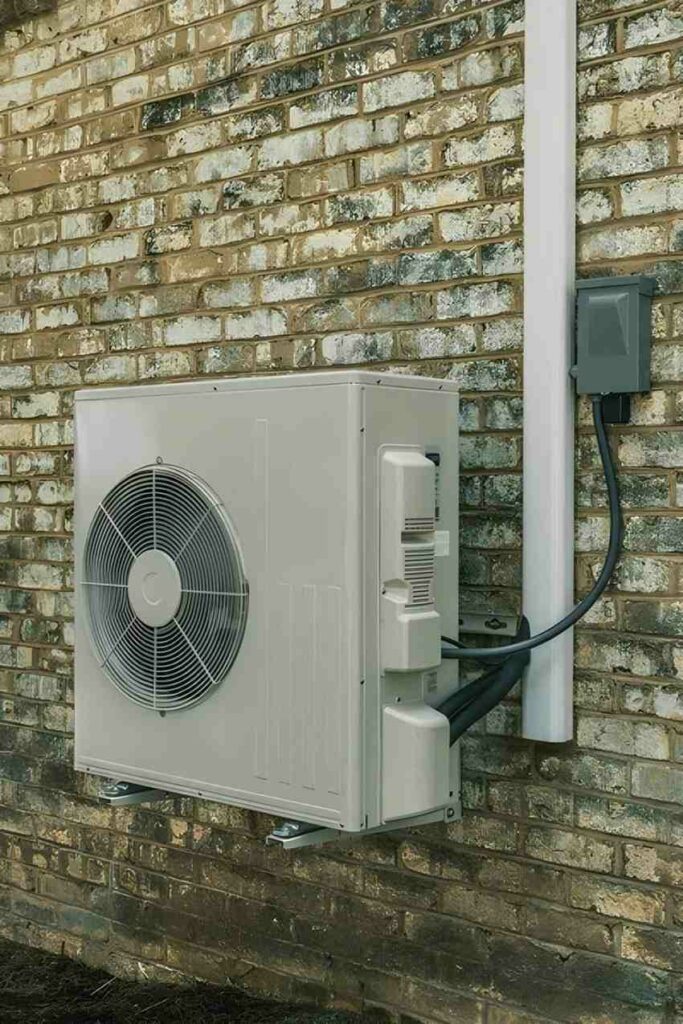
We’ve discussed where the outdoor unit should go in regards to the sunlight and weather, but what other considerations do you need for the positioning of the outdoor unit?
- > A clear area. The outdoor unit needs a clear space to circulate air. You need between 80cm to a meter clear in front of the unit to ensure a good air flow and to stop hot air recirculation.
- > Shade. Keeping it in a shady place, or not in direct sunlight, helps prevent the unit from overheating. The hotter the unit the more it will cost to cool your house down in summer.
- > Noise. The split system units are not totally quiet, so try and keep them away from open windows or bedroom windows. Also try and keep them from boundary fences as you don’t want to disturb your neighbours.
- > Distance. Keep the outside unit close to the indoor unit if possible. The longer the pipes between the two the less effective the heating and cooling will be.
- > Environmental. Avoid dusty areas, or places that can be prone to falling leaves. This can cause your outdoor unit to get dirty and work less efficiently, and you’ll need to clean it more often.
Talk to Templestowe’s Heating and Cooling Experts Before You Install
Choosing the right split system for your home is a good decision. Where to place it on your wall is the next one to make. The right spot can mean all the difference between genuine warmth and lower energy bills. You need to consider wall direction and ceiling height, room shape and the placement of the outdoor unit. There’s a lot to get right and you have the team here to help.
Templestowe Heating and Cooling takes the guesswork out of the process. We can assess your home, take measurements and recommend the ideal sized unit and install it in just the right position for maximum heat efficiency.
Get in touch with us today before the cold sets in. Your toes will thank you.
Serving Doncaster, Templestowe, Warrandyte and the Manningham Region
Templestowe Heating and Cooling have been serving the families of Manningham region and beyond since 1962. Our knowledge and expertise coupled with first class customer service, has given us a solid 5-star Google rating from over 130 reviews.
If you’re in Templestowe, or live in and around Doncaster, Donvale, Warrandyte and the leafy north east suburbs, and you’re in the market for reliable heating and cooling for your home, look no further than the quality products from Templestowe Heating and Cooling. We work with all the best brands. We can install, repair and give you regular servicing of all heating and cooling.
Try us today before the weather gets to you.
 Mitsubishi Electric Diamond dealers